Category: Uncategorized

Trauma, the link between humans and chimpanzees
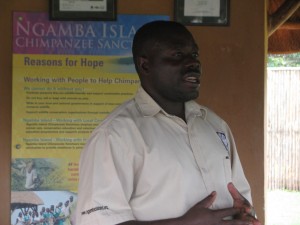
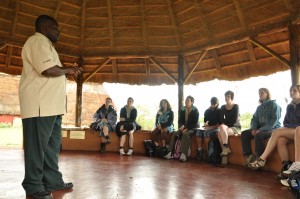
Learning about traumas and chimpanzee storiesFollowing a day of hearing about chimpanzees at Ngamba island and at the Ugandan wildlife education centre, we focused on observing and learning about their behaviour and their stories of rescue and backgrounds.  This brought up many questions for us which we discussed as a group. We then had the opportunity to raise these questions with the head vet at the centre and also a primate keeper.

As the past few days have been focused on discovering the behaviours, emotions and stories of the chimpanzees we have now begun to focus on the children, and how we can incorporate the two together.

In the afternoon we also learnt about childhood trauma in Uganda, and the differences in culture and acceptable behaviour that differens from more westernised countries.
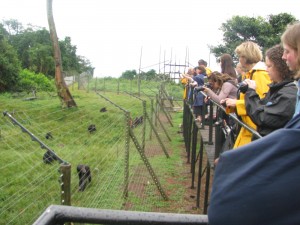
Observing behaviour of chimpanzees

We discussed about the feelings and emotions that may be shown by children who have been abused in some way or who have suffered other traumas in their lives.  We spoke about the differnce in individuals dealing with these emotions, and how this will affect people in different ways.  We also talked about the support network around the children, which again is very individual.

We also know that some work or activities may bring up memories or ‘triggers’ for the children, and how we could turn this into a positive way with the work that we will be doing.  Again, we are approaching this with the children being able to express their feelings in a positive way, and allowing us to be part of what they are expressing, but to give them a safe environment to do this in.  Understanding that approaching problems of trauma in an intrusive way, may cause more damage to a child emotionally once we have left.

We are now looking forward to the next few days where we will be working with two groups of children from two homeless children charities, which we visited earlier this week.

Ngamba Island chimpanzees and beautiful beads

Volunteers learn from Ngamba staffToday we left our beds at 6.45 for an early breakfast and a ride on a boat which was going across Lake Victoria.  Lake Victoria is the second largest freshwater lake in the world and it was a pleasure to be riding on it.  Although it was raining and the water quite choppy, the volunteers managed to rest.
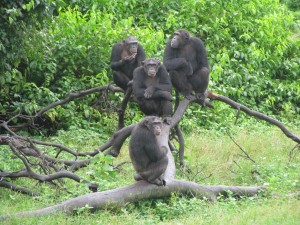
Our boat trip was to Ngamba Island chimpanzee sanctuary, a 100 acre piece of land, which is home to 44 chimpanzees who have come from rescued background.  95% of the land is forested and the chimpanzees that live here are now a well formed group.  Many of the chimpanzees will make their own nests in the forest, so do not need to spend as much time around humans as the others.   Many more of the chimpanzees prefer to sleep in the holding cages which they are free to come into at night time, where they will also get to eat their food. This is also a place where they are able to monitor the chimpanzees.

Chimpanzees at Ngamba

Attached to the holding cages are cages which house chimpanzees who have had social problems or who are still being integrated slowly into the already formed group on the island.

Silver (our guide) spoke to us about the noises that the chimpanzees make and the pant hoots and excitable sound that they show when the food is arriving.  This sounded alarming to many of the volunteers who thought this may sound like they chimps were fighting, so their minds were put at rest after Silver had explained this.

We were then given a tour of the offices and treatment rooms.  The chimpanzees have full health checks once a year.

Every chimpanzee has its own record/diary which the handlers use often.

We were then taken to the viewing platform, which is on the edge of the forest.  This is where the chimpanzees get fed. They get fed several times a day, but this particular feed is to allow visitors the chance to observe the chimpanzees on the outskirts of the forest.  This was very interesting for us and we were able to look at the behaviour of some of the chimps, and could see how close to humans they were.

Stany (co founder of Ngamba island) spoke to the volunteers after the tour about the chimpanzees that were at the sanctuary and their emotions and behaviours that could be related back to children and humans.  He focused on the rehabilitation of a chimpanzee from their difficult background which he then related to humans and their problems in integrating back into society.

Tree planting the Yebo tree

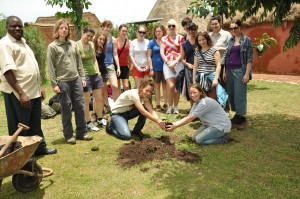
The Yebo volunteers were then asked to plant a tree which is part of an educational program which is supported by Silver.  We helped plant one tree which we named Yebo, we hope that this tree will grow strong and benefit the environment.

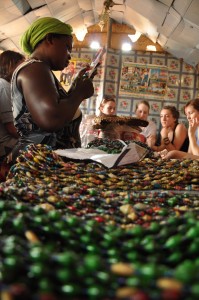
After our visit to this beautiful island we went onto another island, meeting the local people who make and sell jewelry.  These are beautiful and hand made by the ladies at the island with paper and varnish.  The volunteers were able to make their own bead, and also support the ladies by purchasing some of the beads and necklaces that had already been made.  The ladies here were trained to make these beads in order to help them sustain a small wage for living.

Bead making

We then played with some of the children on the island, and then stepped back on our boat and arrived back at UWEC.

The information and observations that we saw today should help us in our projects that we will be running with the children and the psychology side of things that we aim to acheive.

Visiting ‘Street children’

Written by Shalini Raman and Jasmine Anilmis.

spinning!

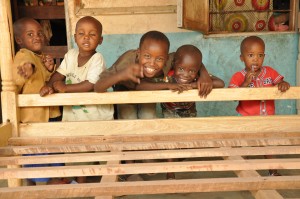
Today we visited the ‘Raising hope organisation’ which is just outside of Kampala, which has been set up to support children who live on the street, (street children). We were greeted by the founder of the orgaisation, Patrick, who had previously been to see us the day before. We were instantly welcomed by the children with hugs and chatter and never before have I been welcomed so warmly, and yet, these were young children that we have never met before.  We spent some time talking to the children and it was lovely to be around such enthusiastic children. Patrick gave us a tour of the centre, including where the children sleep and learn. Each bedroom had around 2-3 bunk beds with 2-3 children sleeping in each one of the beds. It was very inspiring to see babies to teenagers living in such a small spaced area together. Every single child appeared to be full of happiness. Patrick is just 19 and has managed to create this project himself.

Just before we said our farewell the children performed a song and dance for us and encouraged us to join in, and everyone appeared to be having a great time.

.

We then visited the Katwe youth development centre in Kampala which is also for ‘street children’. It appeared to be a very small village where the children lived and played. A group of young people performed some music to us, singing, playing drums, harps and dancing, which we all found amazing.

After meeting the chairmen we were given a tour of the centre, where we saw where they teach the children skills such as carpentry. This aims to benefit the children in the future to earn a living from skills such as these.

Today was so incredible and I wish it could have gone on forever!

Meeting volunteers and the people of Uganda

The Ugandan Easter Yebo volunteersWe arrived at the Ugandan Wildlife Education Centre (UWEC) ready to start our Yebo support project which has begun today (1st April).  We are staying in Bandas next to Lake Victoria (the second largest fresh water lake in the world).  UWEC is home to many animals such as lions, zebras and rhino as well as our focus – chimpanzees.  The staff at UWEC are very welcoming and the views out onto the lake are stunning.  We are now with all of our volunteers and are looking forward to the next 2 weeks.
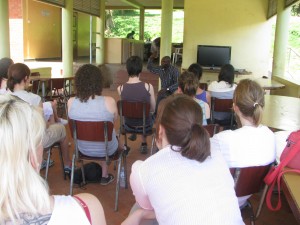
Today we met some inspiring people.  Peace, education coordinator, talked to us about culture. Figal, the manager of an organisation, spoke to us about an organisation who supports and homes children who have been forced to live on Listening to inspiring peoplethe streets, often due to to having lost their parents to HIV or war.  The children (both boys and girls) are given food, a pleace to sleep, education and skills training, and continued support for finding jobs and homes when they reach this stage.
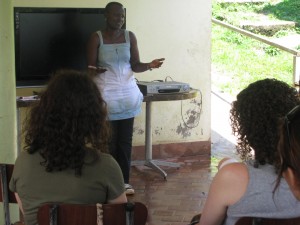
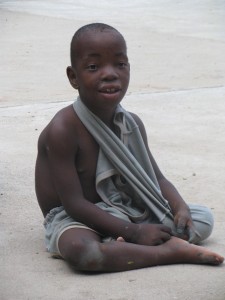
Patrick, is a director of a similar organisation.  Patrick is just 19 years old, which inpsired many of us by what he has acheived at such a young age.  He is the director of an organisation who supports 40 ‘street children’.  Patrick tols us of his life story and experiences due to being a street child himself and how he has turned these negative experiences into positive ones.

Cultural talk given by Peace

All of these people have been very inspiring and remarkable.  It will be really exciting and rewarding to help them in their projects and learn more about them in the next few days.

Behind all the smiles

Letaba schoolOur last blog of South Africa, March 2010 before our travels to Uganda, we wanted to leave you  with a small idea of the reality for most of these children.
We first walked into Letaba school in 2007 and were greeted with warmth, smiles and a joyful laughter.  We came away thinking how happy these children were, with their physical disabilities and that they were making the most of life.

We visited more and more, eventually supporting them through Yebo.  The stories we heard from the teachers in 2009 made us understand just slightly, a bit more of the traumas that are going on for the children.

This trip of March 2010, we gained more information, which led us deeper into the knowledge of the sadness, the pain and the suffering of many kinds of abuse that these children have had.  This went even deeper as we learnt that their traumas still carry on throughout their time away from the school.

We look at this project now with different  eyes, learning as we go along.

Of course, the traumas that are happening for these children we are unable to stop.  The traumas that are so serious and disturbing also bring heavy and intrusive emotions if disturbed in the wrong way.

What we can try to do for these children, however hard their life is, and however they cover up their pain and manage to still bring smiles that give joy to others, is to bring as much happiness into their lives that will give them a chance to express their feelings in a positive way, through activities that they can relate to their own situations.  A gentle approach to support of emotions.

Meeting chimpanzees for the first time in their lives

Meeting chimpanzees

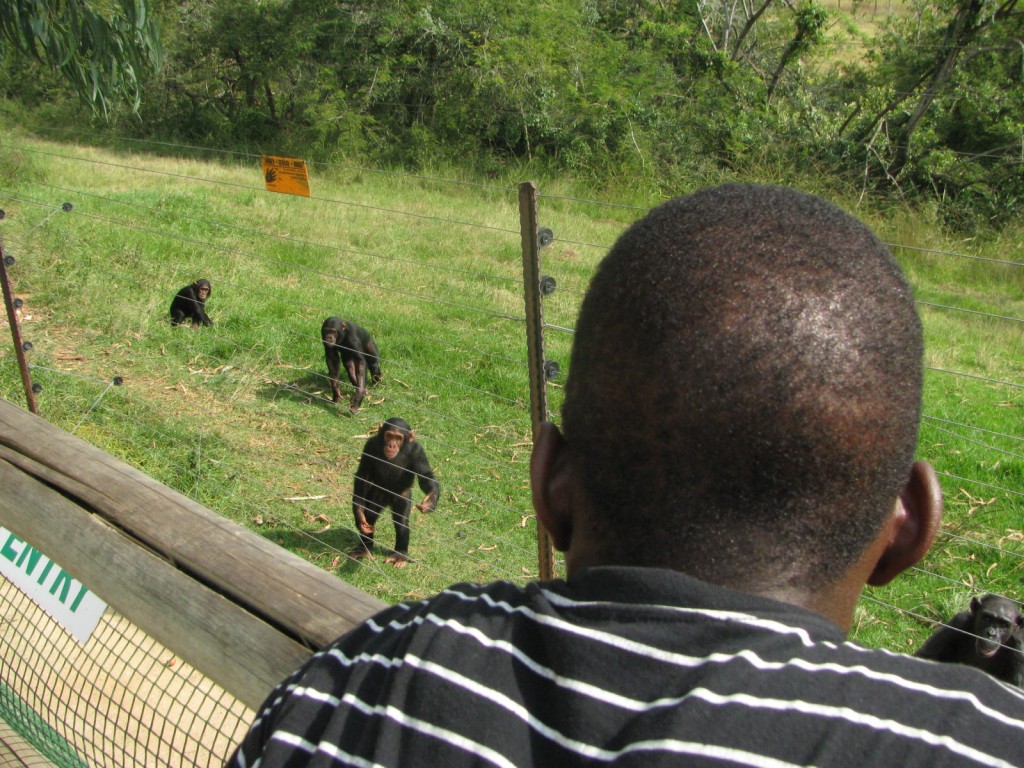
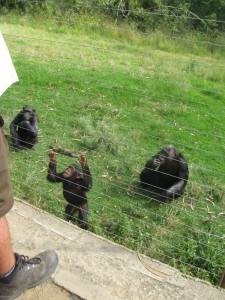
On Tuesday we took a group of children to Chimpanzee Eden, to meet chimpanzees, one of our closest relatives, expressing many of the same characteristics and emotions as ourselves.  Many of the chimpanzees have had stories of rescue through their mums being killed, leaving them as orphans, or being abused in many different ways.

The children laughed as they were taken around to meet the chimpanzees who were in their well managed and safe enclosure, as they made loud noises that the children liked!

Chimpanzee EdenTheir teachers helped to explain to them the comunication between each chimpanzee and the stories of rescue, with an aim that the children would be able to relate to many of these traumatic experiences.  This aim is not to verbalise it into a distressing manor, but in a way where they can purley relate their experiences to other animals, an understanding, we hope that also animals go through traumas like us.

They especially liked the smaller chimpanzees as they jumped around asking for food and trying to get the attention of the children.

We found this a fascinating experience and we focused on the children and their reactions.

We hope to bring the children back here this summer, allowing them to have more experiences.

After the tour of the chimpanzees we took them into the education centre where they watched with, what appeared to be great interest of  films of the chimpanzees at the sanctuary when they were rescued and the very small conditions they were living in.

One child remarked to her friend ‘That looks small place to live, like where I stay’